Land-based
The primary configuration, with site infrastructure sized to the feedstock, access, services and local product demand.
When infrastructure is too costly to build alone, share the capability. CIAP proposes shared specialist equipment, engineering and operating expertise rather than a complete standalone technology stack for every location.
Common engineering, training, maintenance and materials expertise may reduce duplication. Each application still requires its own feedstock assessment, permits, product markets and viable operating agreements.
The primary configuration, with site infrastructure sized to the feedstock, access, services and local product demand.
Potential staged deployment and redeployment as requirements change, subject to transport, commissioning and site readiness.
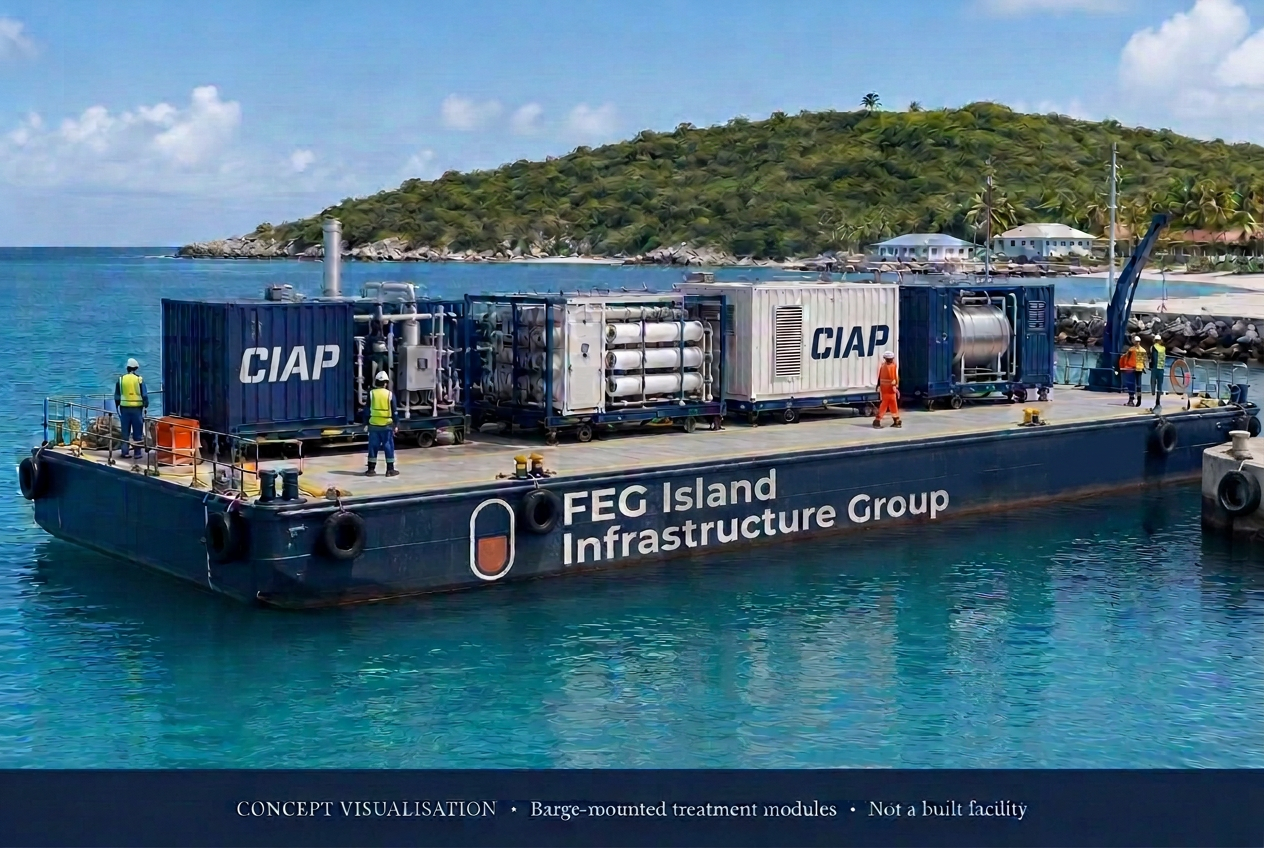
A possible option for smaller or access-constrained locations. Stability, marine safety, mooring, utilities and coastal approvals require feasibility work.
An outage in one thermal line need not stop other lines. Shared services, logistics, utilities and specialist staffing remain common dependencies and require redundancy, contingency capacity and maintenance planning. Mobility is not a substitute for operational safeguards.
Read the risk and resilience evidenceLocal materials production can support employment beyond the processing plant: skilled operations, maintenance, deliveries and shared services. Training and local workforce development would form part of deployment planning.
Potential roles in block manufacture, aggregate production, material testing, quality control and product dispatch—keeping more construction-material value locally.
Sorting, metals separation and recovery, equipment operation and preparation of recovered metals for local use or onward sale.
General thermal-treatment (incineration) operation, emissions monitoring, maintenance and site safety, with waste-to-energy operating roles where energy recovery is viable.
Where feasible, sand-battery thermal-storage operation and maintenance, alongside logistics and deliveries for useful heat services.
Potential desalination plant operation, water-quality monitoring, maintenance, storage and water deliveries where a viable, approved water system is included.
Potential barge crews, marine engineering, mooring and transport roles where barge deployment is feasible; post-disaster response planning, logistics and safe debris-processing operations where authorised.
These are potential employment pathways, not confirmed jobs, recruitment offers or job-count forecasts. Roles depend on feasibility, local demand, funding, approvals, safety requirements and training. Energy, sand-battery, desalination, marine and disaster-response activities are conditional options, not committed services.
Candidate locations / examples · potential application only
| Location | Why it is listed | What has not been established |
|---|---|---|
| Guyana | Large agricultural residues — rice husk and bagasse — alongside a growing household waste stream | No site, feedstock supply, government interest or unit has been confirmed |
| Dominican Republic | Large household waste volumes and heavy reliance on imported construction materials | No site, feedstock supply, government interest or unit has been confirmed |
| Cayman Islands | Limited remaining landfill capacity and high demand for imported aggregates | No site, feedstock supply, government interest or unit has been confirmed |
Listing a location here indicates no interest, participation or agreement by any government or local authority. Feasibility assessment would establish site, feedstock, logistics and local demand before anything is proposed.
Feasibility must establish utilisation, ownership, service agreements, logistics and deployment economics before a shared operating model can be committed.
Support the Feasibility & Pilot